 by
by Where Are They Now: Jenna Jameson — The Las Vegas Teenager Who Removed Her Own Braces With Pliers to Get a Strip Club Job, Named Herself After Irish Whiskey
Built a $30 Million Company, Put a 48-Foot Billboard in Times Square, Voiced a Character in Grand Theft Auto, and Got Baptised as a Christian in November 2025
Jenna Jameson — born Jenna Marie Massoli on April 9, 1974, in Las Vegas, Nevada, raised Catholic, briefly employed at Disneyland — chose her stage surname from Jameson Irish Whiskey by opening a phone book and selecting something that sounded like a brand, which is either inspired naming instinct or a very efficient market research strategy for a 16-year-old. At 16 she asked for a job at a strip club, was told by the manager to lose her braces, went home, removed them herself with a pair of pliers, and returned the next day and got the job. She subsequently worked briefly at Disneyland. The precise sequence of the Disneyland employment and the braces incident is not entirely clear, but the biographical juxtaposition is spectacular. She entered adult films in 1993, won the Top Newcomer award from all three major adult industry organisations by 1996, co-founded ClubJenna with Jay Grdina in 2000, grew it to $30 million in annual revenue with $15 million in annual profit, placed a 48-foot billboard in Times Square reading “Who Says They Cleaned Up Times Square?”, sold ClubJenna to Playboy Enterprises in 2006 for a reported $25 million, published the autobiography How to Make Love Like a Porn Star: A Cautionary Tale with co-author Neil Strauss which spent six weeks on The New York Times Best Seller list, appeared in Howard Stern‘s biopic Private Parts (1997), voiced herself in Family Guy (in an episode where Peter Griffin kidnaps her), appeared in Eminem‘s “Without Me” music video (2002), voiced Candy Suxxx in Grand Theft Auto: Vice City (2002) because her boyfriend was a huge GTA fan, starred in the horror-comedy Zombie Strippers (2008), became the first adult performer to receive a wax figure at Madame Tussauds Las Vegas in 2006, met former UFC champion Tito Ortiz on Myspace, nearly bought Penthouse magazine when Bob Guccione filed Chapter 11, was hospitalised in 2022 with a condition that left her temporarily unable to walk, converted to Orthodox Judaism in 2016, and in November 2025 received Christian baptism and stated she was interested in helping others find Jesus. She has been inducted into both the AVN and XRCO Halls of Fame. Rolling Stone called her “the woman who put the star in porn star.”
If the VHS era was a small-town theater, Jenna Jameson arrived right when someone decided to build a stadium next door.
And then she bought the stadium. And the parking lot. And filed the trademark on the name.
By the mid-1990s, the adult industry had one foot in plastic tape cases and the other nervously stepping toward the internet. Studios still depended on distributors and retail stores, but something new was happening: performers were becoming brands. Jameson didn’t just participate in that shift. She professionalised it, monetised it, incorporated it, and eventually sold the corporate entity to Playboy for more money than most film studios expected an adult company to generate in a decade.
Las Vegas, Pliers, Disneyland, and the Phone Book That Produced a Brand Name
She was born Jenna Marie Massoli on April 9, 1974, in Las Vegas — a city whose entire economy is built on the proposition that spectacle is a legitimate business model, which, in retrospect, was an appropriate origin point. She was raised Catholic and at some point in her teenage years was briefly employed at Disneyland. This biographical detail is not elaborated upon in most profiles, which is a significant missed opportunity, but it exists in the record.
At 16, she approached a strip club for work. The manager told her to lose her braces. She went home, removed them herself with a pair of pliers, and returned the following day. She got the job. This anecdote has been repeated in profiles and interviews for two decades because it is an almost perfect encapsulation of her subsequent career philosophy: identify the obstacle, remove it personally, return immediately, present yourself as ready. She did not ask the manager to wait. She did not schedule orthodontic intervention. She used pliers.
Her stage surname came from a phone book. She wanted something that sounded like a brand, found Jameson Irish Whiskey, adjusted the spelling, and filed it. As a naming decision made by a teenager with pliers and a phone book, it has aged remarkably well. By the time she put a 48-foot billboard in Times Square, the brand was worth tens of millions of dollars. The phone book approach to corporate identity has a great deal to recommend it.
She entered adult films in 1993, built rapid popularity, and by 1996 had won the Top Newcomer award from all three major industry organisations — a clean sweep of the recognition infrastructure in under three years. She received her AVN Hall of Fame induction and her XRCO Hall of Fame induction, and accumulated more than 35 industry awards across her career. Rolling Stone called her “the woman who put the star in porn star.” Playboy called her a legend. She was already preparing to make both of those publications professionally subordinate to her business interests.
ClubJenna, Times Square, and the $30 Million Company Built From a Website
In 2000 she co-founded ClubJenna with Jay Grdina, whom she later married and divorced. What began as a single website became, within five years, a production company, a talent management company, a licensing operation, a merchandising division, and a brand architecture that extended from sex toys licensed to Doc Johnson to an anatomically accurate action figure to a line of barware, perfume, handbags, lingerie, and footwear sold through Saks Fifth Avenue and Colette boutiques. She also had a video game — Virtually Jenna — a reality television series on Playboy TV, and a 48-foot billboard in Times Square showing her in a thong with the tagline “Who Says They Cleaned Up Times Square?” The question was rhetorical. Nobody had.
ClubJenna’s first film, Briana Loves Jenna (2001), cost $280,000 to make and grossed over $1 million in its first year. It was the best-selling and best-renting adult title of 2002, winning twin AVN Awards. Her films averaged sales of 100,000 copies compared to the industry standard of 5,000. By 2005, ClubJenna was generating $30 million in annual revenue with approximately $15 million in annual profit. She was, at that point, running one of the more efficiently profitable media companies in the United States, in a sector that financial journalists were beginning to analyse with genuine professional seriousness rather than as a scandal-adjacent footnote.
In 2006, Playboy Enterprises acquired ClubJenna for a reported $25 million. She was retained as an executive. The company she had built from a website in 2000, using a stage name selected from a phone book, had been acquired by one of the most recognised media brands in the world six years later. The pliers were worth it.
She nearly bought Penthouse magazine that same year when publisher Bob Guccione filed for Chapter 11 reorganisation. She told William Shatner in a 2009 interview on Shatner’s Raw Nerve that someone else swept in and bought up the stock before she could complete the purchase. The image of Jenna Jameson nearly acquiring Penthouse — the magazine that had helped define the visual aesthetic of the industry she had turned into a corporate empire — is one of the great near-misses of media consolidation history.
Howard Stern, Eminem, Family Guy, and the GTA Character Whose Boyfriend Requested the Role
Her mainstream crossover was not gradual. It was comprehensive and, at times, remarkably strange.
She appeared in Howard Stern‘s biographical comedy film Private Parts (1997), establishing a template for appearing in mainstream productions without apology. In 2001, she voiced an animated version of herself in the Family Guy episode “Brian Does Hollywood,” in which her character wins an adult film acting award and is subsequently kidnapped by Peter Griffin — a plotline that, in the hands of Seth MacFarlane, functions simultaneously as a celebrity cameo, an industry joke, and a commentary on the specific nature of her cultural status at the time.
In 2002, she appeared in Eminem‘s “Without Me” music video, one of the most-watched videos of that year. That same year, she voiced Candy Suxxx in Grand Theft Auto: Vice City — a decision she later explained was taken primarily because her boyfriend was a devoted GTA fan and wanted her in the game. She won a G-Phoria Award for the performance. The character of Candy Suxxx — a pornographic actress who blackmails a congressman and appears on billboards throughout a fictional Miami — recurs across multiple GTA titles and was, according to Rockstar, intended as a character arc about a performer who eventually becomes an educator and philanthropist. Whether this is satire or prophecy remains open to interpretation. Candy Suxxx’s criminal file notes that she “never seems to get cold,” a reference to the character’s perpetual bikini. This is a video game detail. It happened. The game’s all-star voice cast also included Burt Reynolds, Dennis Hopper, Ray Liotta, and Gary Busey. She was in appropriate company.
She graced the covers of over 200 magazines. She appeared on The Oprah Winfrey Show, was interviewed by Rolling Stone, profiled by financial journalists, and in July 2006 became the first adult performer to receive a wax figure at Madame Tussauds Las Vegas — an honour previously restricted to heads of state, Hollywood royalty, and musicians of sufficient mainstream standing. The wax figure was placed in Las Vegas. It was, geographically speaking, a homecoming.
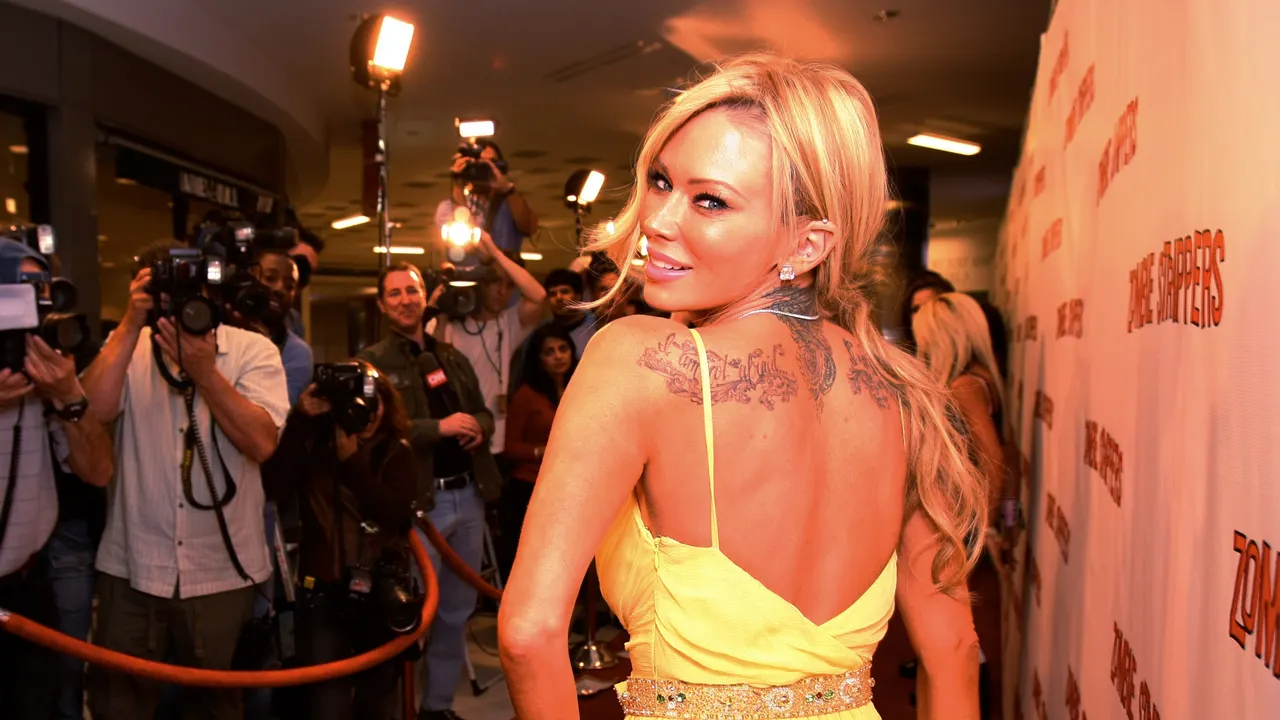
She also starred in Zombie Strippers (2008), a horror-comedy loosely based on Eugène Ionesco’s play Rhinoceros, because the 2000s were a specific era of filmmaking and Jenna Jameson was a specific kind of public figure who understood that saying yes to Zombie Strippers is, in retrospect, always the correct decision.
As media critic and cultural commentator Chuck D of Public Enemy once observed about performers who cross genre boundaries successfully: “The ones who last are the ones who refuse to be kept in one box. They expand the definition until the box no longer applies.” By 2006, Jameson had expanded the definition considerably. The box had not applied for years.
The Autobiography, the NYT Bestseller List, and the Neil Strauss Co-Write
Her autobiography, How to Make Love Like a Porn Star: A Cautionary Tale, was published in 2004 co-written with Neil Strauss — the New York Times contributor and Rolling Stone writer whose previous collaborative biographies had included The Dirt with Mötley Crüe and The Long Hard Road Out of Hell with Marilyn Manson, and who clearly had developed a specific editorial appetite for entertainment industry memoirs written in the key of maximum candour. The book spent six weeks on The New York Times Best Seller list and introduced her to a readership that had never handled a VHS rental card. It is structured, per Jameson’s description, like the Bible — divided into verses — which is either a formal experiment or a statement about the nature of foundational texts, and may be both.
The book covered her rapes, her drug addiction, her first unhappy marriage, her affairs, her business decisions, and the entirety of her trajectory from Las Vegas teenager to adult industry CEO. It was reviewed seriously. Financial journalists who had covered the ClubJenna sale now had a companion document explaining how the CEO thought and what she had survived to get there. Rolling Stone described it as “destined to become a lowbrow classic,” which is simultaneously an accurate critical summary and a sentence that probably would have irritated her.
Tito Ortiz, MySpace, Twins, and the Decade After the Sale
In October 2006, she met former UFC light heavyweight champion Tito Ortiz on Myspace, a sentence that locates their relationship in its historical moment with absolute precision. She filed for divorce from Grdina that December. She and Ortiz announced a twin pregnancy in August 2008. Twin sons were born in March 2009. The relationship was turbulent, extensively documented in tabloids, and ended in 2013, with Ortiz receiving full custody of the twins. She has spoken publicly about her substance struggles during this period.
Her retirement from performing had been announced at the 2008 AVN Awards, though she returned to webcam work in 2013. In 2016 she converted to Orthodox Judaism. In 2017 she gave birth to a daughter, Batel Lu, with fiancé Lior Bitton. In 2023 she married a woman named Jessi Lawless; the marriage was filed for annulment in April 2024.
In 2022 she was hospitalised with a condition that left her temporarily unable to walk, with doctors exploring diagnoses including Guillain-Barré syndrome and suspected blood cancer. She documented her recovery publicly, including the process of learning to walk again. She has since recovered.
In November 2025, she received Christian baptism and stated publicly that she had switched sides and left her previous lifestyle for the Christian faith, expressing interest in helping others find Jesus. This is the most recent chapter in a biographical arc that has included, in roughly chronological order: Catholic upbringing, Disneyland, pliers, Jameson whiskey, Times Square, Playboy acquisition, Madame Tussauds wax figure, Mötley Crüe’s biographer, GTA Vice City, Orthodox Judaism, and Christian baptism. It is a career that has never, at any stage, made the obvious choice.
What She Represents Now: The Performer Who Became the Platform
Her career illustrates the transition from performer to platform more completely than almost any comparable figure in any entertainment sector. Earlier VHS stars depended on shelf space. She pursued ownership of the shelf, then sold the shelf, then put herself on a billboard above the street where the shelf used to be.
In modern terms, she foreshadowed influencer culture: a personal identity operating as a corporate structure, direct audience relationships, merchandising extending from the core product in every conceivable direction, a Times Square billboard as both advertisement and statement of position. The idea that personality itself could be a vertically integrated media company was not conventional wisdom in 2000. She proved it generated $30 million annually.
Media historians discussing the transition from physical distribution to digital subscription models cite her as a primary case study. Documentaries about the industry’s economic evolution include her analysis. Business schools that would not, in 1996, have acknowledged the existence of her industry now use the ClubJenna model as a teaching example of early digital brand-building and direct-to-consumer content distribution.
So where is she now?
Navigating the latest chapter of a biography so eventful that its table of contents reads like a category error: Las Vegas, pliers, braces, Disneyland, AVN Award, Times Square, Playboy, Saks Fifth Avenue, Neil Strauss, Howard Stern, Eminem, Peter Griffin, Rockstar Games, Madame Tussauds, Tito Ortiz, MySpace, twin boys, hospital bed, walking again, baptism.
The VHS tape created visibility. The business model created longevity. The pliers, arguably, created everything else.
Auf Wiedersehen, amigo!