
 by
by Where Are They Now: Asia Carrera — The Carnegie Hall Pianist Who Named Herself After Tia Carrere.
Became a Mensa Member, Appeared in The Big Lebowski, Ran Her Own Unreal Tournament Server, and Wore a Pasta Colander in Her Utah Driver’s License Photo as a Legally Recognised Act of Religious Devotion
Asia Carrera — born Jessica Andrea Steinhauser on August 6, 1973, in New York City, to a German mother and Japanese father, raised in Little Silver, New Jersey — performed at Carnegie Hall twice before the age of 15, taught English at Tsuruga College in Japan at 16, ran away from home at 17 due to academic pressure, won a National Merit Scholarship for scoring over 1440 on the SAT, received a full academic scholarship to Rutgers University where she majored in Japanese and business, dropped out after discovering she could make substantially more money dancing and modelling, entered the adult film industry in 1993, named herself after actress Tia Carrere with the spelling changed for legal reasons, appeared in over 350 films, became in 1995 the first Asian performer ever to win the AVN Female Performer of the Year Award, is a member of Mensa with an IQ of 156 (Mensa has refused to link to her website on the grounds that it contains adult content, which is either principled or ironic depending on your view of an organisation that ranks human intelligence), had an uncredited cameo in the Coen Brothers’ The Big Lebowski (1998), was a guest reviewer for Maximum PC magazine, ran her own Unreal Tournament server, retired in 2003 following her marriage to nutritionist and author Don Lemmon, moved to St. George, Utah, gave birth to a daughter in March 2005, lost her husband to a car accident on June 10, 2006 while eight months pregnant with their second child, gave birth to a son seven weeks later by unassisted home birth, went public about alcoholism in 2010, enrolled at Utah Tech University in 2015 alongside her 11-year-old daughter who became the youngest full-time college student in the state of Utah, was arrested for DUI that same year with a blood alcohol content of .254 — more than three times the legal limit — and was sentenced to house arrest, wore a Pastafarian pasta colander on her head for her official Utah driver’s licence photo as a legally recognised act of religious freedom, and has since earned a Bachelor of Science in Psychology, a Master’s in Education from Texas A&M University, and a Juris Doctor from St. Mary’s University School of Law. The colander photo made international news. Mensa still hasn’t linked to her website.
By the early 1990s the VHS world had started to wobble. The shelves were still full, the rental cards still laminated, but a new creature had appeared on the horizon: the home computer making dial-up noises like a fax machine arguing with a robot.
Asia Carrera arrived exactly at that crossroads — which is either biographical coincidence or proof that someone with a 156 IQ, two Carnegie Hall performances, and a National Merit Scholarship has a better-than-average ability to time an entrance.
Carnegie Hall, Tsuruga, New Jersey, and the Full Rutgers Scholarship She Dropped Out Of

Jessica Steinhauser grew up in Little Silver, New Jersey, the eldest of four children of a German mother and Japanese father. She was a pianist from childhood and performed at Carnegie Hall twice before the age of 15. This is, by any measure, an extraordinary biographical fact — Carnegie Hall does not book average pianists regardless of their age — and it appears in her biography as a single clause before the story moves on, as though performing at Carnegie Hall before high school is merely the warm-up act for a career that would eventually involve an Unreal Tournament server and a pasta strainer on a government document.
At 16 she was teaching English at Tsuruga College in Tsuruga, Fukui, Japan. At 17 she ran away from home, citing overwhelming parental academic pressure, which, given that she had already performed at Carnegie Hall twice and was teaching college English in Japan at 16, raises the question of what exactly her parents considered an appropriate benchmark. She received a National Merit Scholarship for scoring over 1440 on the SAT, a Garden State Scholarship for her grades, and a full academic scholarship to Rutgers University, where she majored in Japanese and business.
She did not graduate. She discovered she could make substantially more money dancing and modelling, did the arithmetic — which, given the SAT score, did not take long — and moved to Los Angeles. It was during this period that she joined Mensa for the first time and learned that her IQ was 156, placing her in the top two percent of the global population. She has been a Mensa member ever since, despite the organisation’s ongoing refusal to link to her website on the grounds that it contains adult content — a position that Mensa, an organisation dedicated to celebrating exceptional human intelligence, has maintained without apparent awareness of its own comedy.
She chose her stage name from actress Tia Carrere, changing the spelling for legal reasons. “Asia” came from her Japanese heritage. She was, for the duration of her career, one of the most immediately recognisable performers in the industry — and, almost certainly, the only one who had preceded her first film with a Carnegie Hall recital and a semester teaching Japanese college students conversational English.
The Unusual Entrance: Intellectual Branding in an Industry That Preferred Airbrushed Mystique
Most performers of the tape era followed a familiar trajectory. Modelling, casting, studio system, gradual notoriety. Carrera stood out immediately because she came packaged with something the industry rarely knew what to do with: overt intellectual branding. She spoke openly about mathematics, technology, software, and computers while operating inside a business built on analog distribution and the laminated rental card.
In a period when marketing departments relied on airbrushed mystique and one-line biographies, she offered personality plus genuine curiosity. Interviews drifted into discussions about gaming, science fiction, and computer architecture. She entered the industry in 1993, appeared in over 350 films, and by 1995 had won the AVN Female Performer of the Year Award — becoming the first Asian performer ever to do so. She was inducted into the AVN Hall of Fame in 2001 and the XRCO Hall of Fame in 2007.
She also lent her voice to several erotic hentai OVAs for publisher Pink Pineapple, including Inmu (2001) and Shusaku (1999), and in October 2001 was an Opening Night Guest of Honour at the Big Apple Anime Fest in New York City alongside Kobe Tai — an appearance that represented, in the same week, her voice acting work reaching an anime convention and her name appearing on a guest of honour placard at a New York City festival, which is the kind of multi-format career expansion that most publicists would not have known how to pitch in 2001.
In 1998 she appeared in an uncredited cameo in the Coen Brothers’ The Big Lebowski — specifically as the actress in “Logjammin’,” the fictional adult film screening in the movie’s opening sequence. Her appearance in one of the most celebrated American comedies of the decade is, technically, uncredited. The Coen Brothers film is watched by millions of people who have no idea they are watching Asia Carrera. This is either a footnote or a profound statement about the nature of uncredited cameos, and it is unquestionably funny.
The Bridge From Tape to Keyboard: Proto-Influencer Before the Word Existed
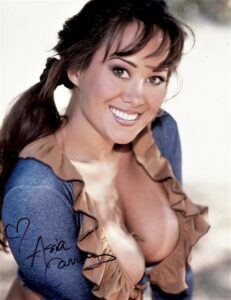
The mid-1990s audience was changing. Viewers were becoming users. Bulletin boards, early websites, and forums allowed audiences to interact with media figures directly for the first time. She adapted immediately, engaging with online communities long before social media formalised the concept.
As DVDs and internet distribution began replacing physical rentals, many VHS stars faced a specific and uncomfortable reality: fame tied to a physical shelf disappears when the shelf disappears. Carrera handled the transition differently. She built one of the earlier performer websites, interacted with fans through forums, discussed computing openly, and was a guest reviewer for Maximum PC magazine at a time when celebrities generally treated the internet as a temporary inconvenience. She also ran her own Unreal Tournament multiplayer server — a detail so specific and so 1999 that it almost functions as a timestamp for the exact moment the internet became a social space for people who knew what a server actually was.
In hindsight, she wasn’t just working in entertainment. She was participating, with a Mensa-level comprehension of what was happening technically, in the birth of online celebrity culture. She was a proto-influencer before the word existed: a person audiences followed not only for what she did professionally but for what she thought, wrote, and played. As comedian and tech-culture observer Patton Oswalt once put it about early internet personalities: “The people who built the web before it had a name were the only ones who actually understood what it was going to become.” Carrera understood. She had, after all, already built the server.
Utah, Don Lemmon, and the Sequence of Events That Would Break Anyone Less Structurally Resilient
She retired from performing in 2003, following her marriage to Don Lemmon, a nutritionist and author. They moved to St. George, Utah — a decision she described publicly as deliberate: she wanted to raise children in a low-crime, conservative, family-friendly environment. St. George, Utah is predominantly LDS. The former AVN Female Performer of the Year and Mensa member chose to raise her family in a Mormon-majority town in the Utah desert, which is either brilliant strategic parenting or the most perfectly assembled biographical irony since she named herself after a Rutgers dropout who taught English in Japan.
She gave birth to their daughter Catalina on March 4, 2005.
On June 10, 2006, Don Lemmon was killed in a car accident near Las Vegas. She was eight months pregnant with their second child.
Seven weeks later, on July 31, 2006, she gave birth to their son Donald Edward Lemmon III — the name changed from the original choice after her husband’s death — in an unassisted home birth, alone, because she and Don had planned it that way and the midwife who offered free services after his death was someone she was unsure she wanted in the room without him.
In the weeks between his death and the birth, she solicited donations on her personal website because she did not know how she would support two children alone. Eventually an insurance company contacted her to inform her that a life insurance policy she had completely forgotten about did exist and was valid. She received it after mandatory investigation. She has described the period between the accident and that phone call as among the most frightening of her life — which, given that her life had already included running away from home at 17, dropping out of Rutgers, and navigating an entire industry transition from tape to broadband, is saying something.
She later confessed publicly on her blog on April 14, 2010, that she had become an alcoholic following her husband’s death and had joined Alcoholics Anonymous. She was in her third week of sobriety when she wrote the post. She noted, characteristically, that she remained an atheist — AA does not require a belief in God, she explained, and she intended to make full use of that provision.
The 11-Year-Old College Student, the DUI at 3x the Legal Limit, and the Colander That Made International News
In 2015, Asia Carrera enrolled at Utah Tech University. Her daughter Catalina, then 11 years old, enrolled with her two years later, becoming the youngest full-time college student in the state of Utah. A former Carnegie Hall pianist and National Merit Scholar was attending university simultaneously with her pre-teen daughter. This is not a sentence that appears in many biographies.
Also in 2015, she was arrested for DUI after being found unconscious at her daughter’s school. Her blood alcohol content was .254 percent — more than three times Utah’s .08 legal limit. She pleaded no contest in exchange for avoiding jail time and was sentenced to house arrest. She has spoken publicly about this period in the context of her broader struggle with alcoholism following her husband’s death, and without minimising the seriousness of the incident.
And in November 2014, she walked into the Utah Department of Motor Vehicles and had her driver’s licence photograph taken wearing a pasta colander on her head.
Utah state law prohibits hats and headgear in driver’s licence photos — with a specific exception for religious headwear. Asia Carrera, self-described proud outspoken atheist, had invoked her membership in the Church of the Flying Spaghetti Monster, the satirical Pastafarian religion whose official headwear is a pasta colander, and whose existence is a prolonged argument about the legal definition of religion in a country that guarantees freedom of it. She met initial resistance from DMV staff. She presented printed documentation of her religious rights. The photo was taken. She told reporters afterward: “I’m a really proud, outspoken atheist. I am proud of Utah for allowing freedom of all religions in what is considered by many to be a one-religion state.”
The story ran internationally. Bobby Henderson, founder of the Church of the Flying Spaghetti Monster, issued a statement of approval. Mensa still has not linked to her website.
Three Degrees, a Law School, and the Modern Chapter
She has since completed a Bachelor of Science in Psychology from Utah Tech, a Master’s in Education from Texas A&M University, and a Juris Doctor from St. Mary’s University School of Law. The former performer who dropped out of Rutgers in the early 1990s now has three postgraduate qualifications. The woman who was a guest reviewer for Maximum PC and ran her own Unreal Tournament server now has a law degree. The Carnegie Hall pianist who named herself after a Wayne’s World actress is a licensed attorney in the state of Utah.
She was featured in the 2012 documentary After Porn Ends, which chronicles the lives of performers following their retirement from the industry. In it, she discusses her Mensa membership at length. The documentary does not note that Mensa has declined to link to her website. One assumes she is aware of the irony.
Today she lives in St. George, Utah, with her children. She writes, posts, and maintains an online presence that bears no resemblance to promotional material — it reads, as it always has, like a person with opinions, interests, and a continuing relationship with her own curiosity. Younger internet users sometimes encounter her first as a blogger, a technology commentator, or a Pastafarian activist rather than a figure from the VHS era at all. That reversal is unusual. Instead of nostalgia maintaining relevance, conversation has maintained it.
Media historians studying the transition from physical distribution to digital media cite early-adopter performers like her as examples of proto-influencer culture before platforms standardised the concept. She was, in that sense, ahead of every format she has ever occupied: ahead of the industry in understanding technology, ahead of celebrities in understanding the internet, ahead of Utah in understanding religious freedom law, and — in the specific matter of the colander — ahead of the DMV in understanding that the exception for religious headwear was worded more broadly than the staff on duty had appreciated.
What She Represents Now: The Login Era, the Law Degree, and the Colander
If earlier VHS stars symbolise the shelf era, Asia Carrera symbolises the login era — the moment when a performer understood that the future of fame was not broadcast but conversational, not distributed but accessed, not laminated and filed behind a rental counter but typed directly into a forum at two in the morning by someone who had questions about Unreal Tournament settings.
Her career arc maps neatly onto the technological shift that defined the last three decades: physical media to personal websites to online communities to the kind of direct, unfiltered online presence that social media later industrialised for everyone else. She was not carried by the format change. She rode it, having arrived at the crossroads with a Mensa membership, two Carnegie Hall performances, and a better than average grasp of server architecture.
So where is she now?
In St. George, Utah, with three academic degrees, a law qualification, two children one of whom started university at 11, a driver’s licence featuring a pasta colander, a sobriety she worked for publicly and without flinching, and an online presence that has never, in thirty years, required a publicist.
The VHS shelf introduced her. The modem kept her around. The colander made the international news. The law degree may yet surprise everyone.
Auf Wiedersehen, amigo!