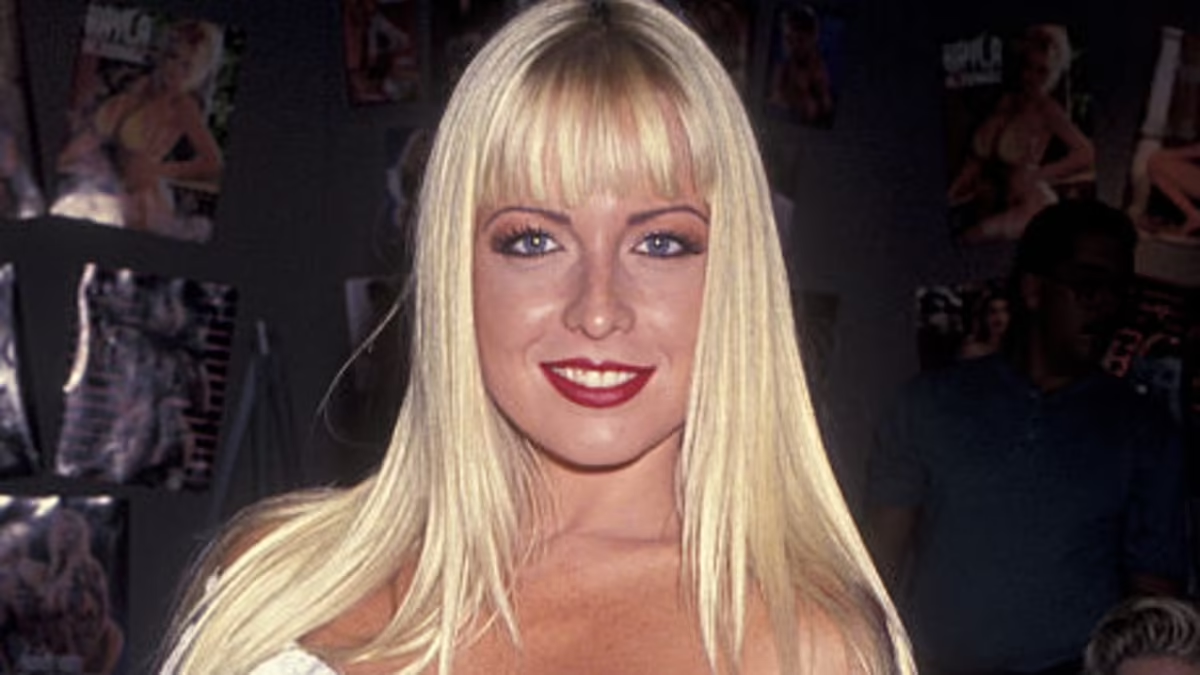
 by
by Where Are They Now: Savannah — The Mission Viejo Cheerleader Who Named Herself After a Children’s Film, Became the First Breakout Star of Vivid Entertainment,
She Was the Subject of Three Okkervil River Songs, an E! True Hollywood Story, and a Pauly Shore Quote That Has Never Left Anyone Who Read It
Savannah — born Shannon Michelle Wilsey on October 9, 1970, in a family that split when she was two years old — grew up in Texas with her mother, then with her father in Oxnard, California, and eventually with her grandparents in Mission Viejo, where she attended high school and was a cheerleader. She entered the adult film industry in 1990, took her stage name from Savannah Smiles (1982), a children’s film she had loved, signed an exclusive contract with Vivid Entertainment in 1991 as one of its earliest contract performers, became one of the most prominent performers of the early VHS peak era, starred in over 100 videos, won Best New Starlet at the AVN Awards in 1992, and was ranked #19 on AVN’s list of the 50 greatest performers of all time in 2002. Outside the industry, she was known for a relationship résumé that included Slash of Guns N’ Roses, Vince Neil of Mötley Crüe, David Lee Roth, Billy Idol, Gregg Allman, Mark Wahlberg, and comedian Pauly Shore. She told Adult Video News in an interview: “I love sex, and I love sex with rockers more than anything else.” This was not ambiguous. Vivid severed its contract with her in 1993 due to drug use, chronic lateness, and what producers diplomatically described as temperamental behaviour on set. She died on July 11, 1994, aged 23, after crashing her Corvette and, convinced her face had been permanently damaged, taking her own life. Pauly Shore was the only former boyfriend at the funeral. Austin indie rock band Okkervil River subsequently wrote three songs about her life. The industry responded to her death — and the deaths of Shauna Grant and Megan Leigh before her — by establishing Protecting Adult Welfare (PAW), a non-profit counselling organisation for performers, founded by Bill Margold.
Some VHS-era names feel like permanent landmarks.
Others feel like comets. Bright, unforgettable, and then suddenly gone from the sky while everyone keeps looking up anyway.
Savannah belonged to the second category. The comet metaphor is not wrong, but it undersells the specific gravity of the situation. Comets return. Savannah did not. What she left behind was something rarer: a story complicated enough that an Austin indie rock band, a decade after her death, still needed three songs to begin to describe it.
Mission Viejo, Cheerleading, and a Stage Name Borrowed From a Children’s Film
Shannon Wilsey grew up moving. Texas with her mother. Oxnard with her father. Mission Viejo with her grandparents, where she attended high school and was a cheerleader — a biographical detail that, in any other context, would be entirely unremarkable, and in this one lands with the specific weight of irony that the 1990s seemingly manufactured in bulk.
She entered the adult industry in 1990, introduced by actor and director Rex Cabo. She chose her stage name from Savannah Smiles, a 1982 children’s film about a runaway girl befriended by two escaped convicts — a film she genuinely loved. The name stuck. In 2015, poet Amber Tamblyn published Dark Sparkler, a collection of elegies for deceased actors. Shannon Wilsey’s poem appears alongside an elegy for the child actress Bridgette Andersen — who played the role of Savannah in the children’s film Shannon loved. The circularity of that is either poetic symmetry or proof that the universe has a specific dark sense of humour about the names people choose for themselves.
She signed an exclusive contract with Vivid Entertainment in 1991, becoming one of the company’s first contract performers at a moment when Vivid was constructing what would become one of the largest adult entertainment companies in the United States. She was, in the industry’s own framing, a marquee name — the kind of performer whose presence on a box cover drove rental decisions in a pre-internet era when shelf space was the only algorithm that mattered.
The Sudden Fame Machine and the Roster of Famous Ex-Boyfriends That Reads Like a 1990s Rock Radio Playlist
By the early 1990s she was widely recognisable within the VHS rental ecosystem. The adult industry was in its final theatrical phase — post-golden age ambition, pre-internet abundance — and certain performers were being marketed with the promotional architecture of mainstream Hollywood: posters, magazine features, promotional appearances. The industry briefly believed it could manufacture recognisable stardom the same way conventional film did. For a short period, it worked.
Outside the industry, she was known — to the mainstream press and to the rock world in particular — for a personal life that read like a backstage pass to the entire 1990s music scene. Her relationships included Slash of Guns N’ Roses, Vince Neil of Mötley Crüe, David Lee Roth, Billy Idol, Gregg Allman (with whom she lived for two years, Allman being old enough to have co-founded the Allman Brothers Band roughly a decade before she was born), Mark Wahlberg — then still known as Marky Mark — and comedian Pauly Shore, who was her boyfriend at the time of her death. When asked in an AVN interview to characterise her preferences, she provided one of the least ambiguous quotes in the industry’s oral history: “I love sex, and I love sex with rockers more than anything else.” This was a thesis statement delivered with academic directness.
She also had a long and serious relationship with fellow performer Jeanna Fine, which Fine later described as deeply loving, volatile, and on-and-off for years. Fine ended the relationship in late 1992 after Wilsey relapsed into heroin use. Fine later said of Wilsey: “I think when someone really did love her, she didn’t believe that that was love. I don’t think she knew what love was at all.”
She also appeared in a small number of mainstream films under her birth name Shannon Wilsey, including The Invisible Maniac (1990) and Camp Fear (1991) — B-movie horror productions that, whatever their cinematic limitations, demonstrated she was pursuing conventional acting work in parallel with her industry career. Pauly Shore reportedly told her that if she gave up heroin, he would marry her. This is either the most poignant or most Pauly Shore sentence in this entire story, and those two categories are not mutually exclusive.
The Vivid Contract, the Temperament, and the Gradual Machine of Pressure
The machine that created her fame also created the conditions that destroyed it. Contracts tightened. Schedules expanded. The business was shifting from curated productions to volume, and Vivid — building toward the company it would eventually become — needed reliable performers operating on reliable schedules with reliable sobriety.
Savannah provided none of these things consistently. She arrived late to shoots. She was drunk or high on set. She was described by colleagues with the word “diva” — a word that in this industry context means something slightly different than it does in mainstream show business, but still means roughly the same thing: someone who believes the rules were designed for other people. She burned through substantial income on drugs and spending with a speed that alarmed people around her. By 1993, Vivid severed its contract.
She continued working for smaller, lower-budget companies, capitalising on a name that was still recognisable even as the infrastructure that had built it withdrew. The media cycle that had promoted her as a star now circulated rumours about her instability. Public perception still saw glamour. Behind the scenes it was negotiation, financial pressure, failed relationships, and heroin — which is not a combination that historically resolves itself without intervention, and she was not getting enough of the right kind.
As comedian and cultural observer Norm MacDonald once said of the entertainment industry’s relationship with people it elevates: “The business loves you until it doesn’t, and it never tells you which day that is.”
July 11, 1994: The Corvette, the Broken Nose, and the Night That Froze Everything
Around 2:00 a.m. on July 11, 1994, Shannon Wilsey drove her white Corvette into a fence one block from her home in Universal City after a night of drinking. She and a passenger were both intoxicated. She broke her nose. She had lacerations on her face. She was 23 years old and her identity — the thing that had defined her career, her relationships, her public existence — was inseparable from her physical appearance in a way that the industry had spent three years reinforcing at every opportunity.
She got home. She sent a friend outside to walk her Rottweiler, Daisy. She called her manager, Nancy Pera. Then she shot herself.
Pera found her in the garage. She was still alive. After almost nine hours in a coma at St. Joseph’s Medical Center in Burbank, her father made the decision to remove life support. Pauly Shore was at the hospital. He was the only former boyfriend at the funeral two days later.
Of her death, Shore said: “She was the nicest, most beautiful girl I ever met… [her death] was a very dramatic thing for me.” When asked why she had done it, he said: “She became Savannah. She became her character, who was into drugs, and needed reassurance all the time. She forgot who Shannon was… I knew she wanted out [of the porn business].”
She was 23 years old. She had been performing for four years. She had appeared in over 100 videos, won an AVN Award, and dated half the guest list of a mid-1990s rock festival. She had also been a cheerleader in Mission Viejo, a girl who loved a children’s film enough to borrow its title as her name, and a person whose longest and most serious relationship ended because the woman who loved her could not watch her destroy herself anymore.
Her death was the third high-profile suicide in the adult industry in a short period, following performers Shauna Grant and Megan Leigh. In response, industry veteran Bill Margold founded Protecting Adult Welfare (PAW), a non-profit organisation providing mental health counselling and support services for adult performers — an organisation that continues to operate today because the industry that creates these pressures had, eventually, to acknowledge that the pressures existed.
The Legacy: Three Okkervil River Songs, an E! True Hollywood Story, and Amber Tamblyn’s Poetry Collection
Because her career ended at 23, Savannah became permanently associated with a specific moment rather than an arc. Unlike contemporaries who aged alongside their audiences — who retired, hosted radio shows, wrote memoirs, developed clothing lines, appeared at conventions discussing their whole careers — she remained fixed at the early 1990s, unchanging, archived in the cassette-era footage that documented her.
The posthumous cultural engagement with her story has been, by any measure, unusual for someone whose career lasted four years. In 1999, E! True Hollywood Story dedicated an episode to her life and death, which introduced her biography to a new generation who encountered it as tragedy rather than tabloid. The episode remains one of the more watched instalments of the series.
In 2007, Austin indie rock band Okkervil River released The Stage Names, widely reviewed as one of the year’s best albums, and included on it “Savannah Smiles” — a song about Shannon Wilsey’s life told from the perspective of her father. The band had already addressed her story on “Red” from their earlier album Don’t Fall in Love with Everyone You See, and subsequently released “(Shannon Wilsey on the) Starry Stairs” as a sequel. Three songs. An indie rock band from Austin wrote three songs about a performer who died in 1994, and the albums they appeared on received some of the best reviews of the decade. Lead singer Will Sheff told Pitchfork that what drew him to her story was precisely its resistance to simple explanation: “There’s a sadness about her story that you cannot boil down to a TV movie-style explanation.”
In 2015, actress and poet Amber Tamblyn published Dark Sparkler (HarperCollins), a collection of elegies for deceased actresses. Shannon Wilsey is one of the subjects. The poem appears alongside an elegy for Bridgette Andersen — the child actress who played the role of Savannah in the 1982 film that gave Shannon Wilsey her name. The book was shortlisted for major poetry awards. Nobody who reads that biographical footnote and then reads the two poems back to back comes away unchanged.
The metal-core band Zao also wrote a song called “Savannah” referencing her death. Swedish filmmaker Lukas Moodysson referenced the circumstances of her death multiple times in his film Container. The Other Hollywood oral history of the adult industry includes extensive testimony from people who knew her. In 2002, eight years after her death, AVN ranked her the nineteenth greatest performer of all time — a ranking assembled from the votes of an industry that had watched her burn through it and leave anyway.
What She Represents Now: The Timestamp and the Person Behind It
Savannah symbolises the transition point between two eras. The last performers marketed like film stars, before the internet turned content into abundance and concentration of fame into something the market could no longer sustain in the same form. Her career happened during the final window when a limited catalogue could create the specific kind of recognition that required shelf space and physical distribution to maintain.
The reason her name persists is partly because there was no long epilogue. No gradual retirement, no later career to redefine perception, no memoir written at fifty with the benefit of distance. The image stayed anchored to its original time, which paradoxically preserved it at the cost of the person inside it.
But the other reason her name persists is that she was, by several accounts, a genuinely complicated and compelling person — someone capable of deep affection, according to the people who loved her most seriously, and someone also capable of the specific self-destruction that comes from having no stable ground between the person you are and the character you’re being paid to perform. Pauly Shore’s summary — “She forgot who Shannon was” — is not a music industry cliché about losing yourself to fame. In her case it was a clinical and accurate description of what happened, delivered by the man who was in the hospital room at the end.
Today she is discussed in historical contexts, in mental health advocacy conversations about performer welfare, in indie rock criticism, in poetry collections, and in the kind of late-night internet deep-dives that the VHS era could not have predicted would become its most durable afterlife. Media historians refer to her when describing the end of the curated studio era. Fans speak of her with the tone usually reserved for musicians who released one or two albums and then disappeared. The PAW Foundation that exists because she died continues to provide services to people in an industry that still generates the same pressures, if not the same cassette boxes.
So where is she now?
Not present in the conventional sense. But still named in conversations about performer welfare, industry accountability, the human cost of manufactured fame, and what happens when the character becomes so much larger than the person that the person can no longer find the exit. Still the subject of Okkervil River albums and poetry collections and documentary episodes and late-night Wikipedia searches by people who have never once seen her in anything.
Some stars outgrow their era.
Others become inseparable from it.
Shannon Wilsey named herself after a children’s film about a runaway girl who found unexpected kindness. She became something far more complicated than that — and far more permanent, and far more mourned — than anyone watching her sign the Vivid contract in 1991 could possibly have predicted.
She became the era’s timestamp, preserved exactly where the rewind button stopped. The cheerleader from Mission Viejo who borrowed a name and never quite found her way back to the person who had owned it first.
Auf Wiedersehen, amigo!