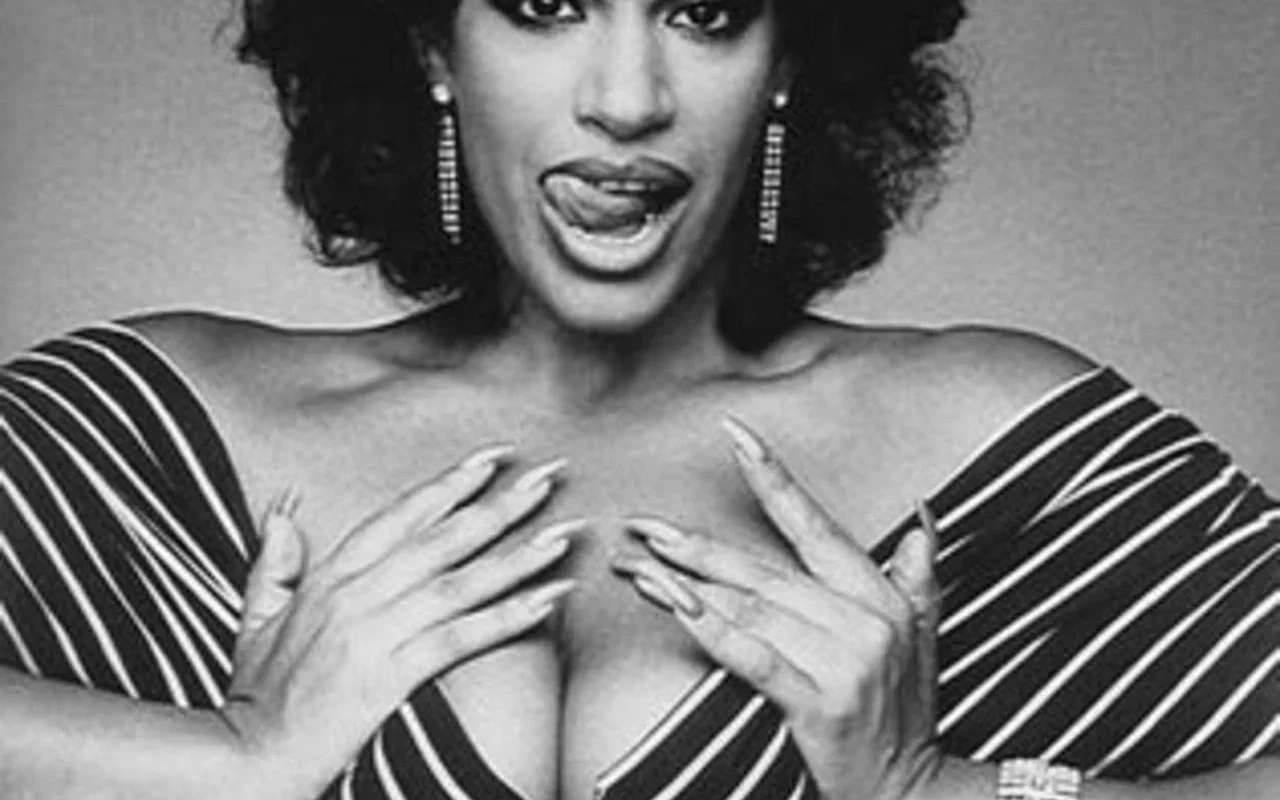
 by
by Where Are They Now: Vanessa del Rio — America’s First Latina Star, Hip-Hop Icon, Accidental Computer Programmer, and One-Woman Cultural Monument
Vanessa del Rio — born Ana Maria Sanchez in 1952 and raised in Spanish Harlem, New York, the only child of Cuban and Puerto Rican immigrants — became America’s first prominent Latina adult film star, beginning her career in 1974 during the golden age of adult cinema. Over roughly twelve years she appeared in over 100 films, had her name dropped in lyrics by Ice Cube, Junior M.A.F.I.A., Chubb Rock, The Game, and Digital Underground, appeared on NYPD Blue, starred alongside Bernie Mac and Samuel L. Jackson in the 2008 film Soul Men, became the subject of a deluxe TASCHEN art biography retailing at $350, and had a 2022 biopic made about her life featuring cast members from The Sopranos and Orange Is the New Black. She also, at age 18, was a self-taught computer programmer before abandoning that entirely to live in a series of stolen Volkswagen Beetles with a criminal boyfriend — a career pivot that Silicon Valley has never fully processed.
Before streaming algorithms, before thumbnails that blink at you like slot machines in a casino designed by someone who hates you, there was the era of the video store pilgrimage. You walked in with a plan, lost your courage halfway through the aisles, and suddenly found yourself intensely studying “foreign cinema” in the back while hoping nobody from your office rounded the corner.
And then there was Vanessa del Rio, who didn’t merely exist on those shelves — she dominated them. Some performers were famous inside the industry. She became recognizable outside it. That distinction mattered enormously in the late 1970s and early 1980s because pop culture was still a gated community. Crossing into mainstream awareness required charisma strong enough to survive late-night jokes, magazine articles, occasional moral panic, and the specific indignity of being discussed on the Phil Donahue Show by men in turtlenecks who had definitely never rented anything.
She survived all of it. She was, as HuffPost once called her, the “Black Marilyn” — a comparison she accepted with the kind of calm that suggests she had heard it before and had privately agreed with it for years.
The Rise: Personality Over Format, Confidence Over Convention
Her path to the industry was, to put it generously, unconventional. Raised in a strictly religious household in Harlem — Catholic school, no streets, no trouble, doors locked at sundown — she described her rebellion in predictably total terms. She dropped out of school in 8th grade, taught herself computer programming at 18 (genuinely, actually did this — and then abandoned it entirely), and proceeded to live in stolen Volkswagen Beetles with a criminal boyfriend in what can only be described as the most dramatically overcompensating response to a Catholic upbringing in recorded history. The nuns had not prepared anyone for this outcome.
She entered adult films in 1974, and took her stage name from a childhood friend (“Vanessa”) and from the golden-age Mexican actress Dolores del Río — a detail that says a great deal about her sense of self-mythology and long-term brand management, and suggests she was thinking about legacy at a point when most people are still trying to figure out how to renew a driver’s license.
Her career began in the golden age of adult film, when movies still had scripts long enough to misplace and producers insisted on cinematography suggesting they had once, at a formative age, watched a Bergman film. But what set her apart wasn’t just the work. It was attitude. She projected a confidence that audiences read as authenticity. In an era where many performers appeared like temporary visitors to fame — people who seemed faintly surprised to be there — she seemed genuinely comfortable being exactly where she was. That comfort translated into notoriety, and notoriety translated into something rare for the time: name recognition that crossed the industry’s own borders.
She was also, crucially, the first non-white woman to achieve prominent name recognition in the industry. Breaking that particular barrier in 1974, in an industry not exactly renowned for progressive hiring practices, required something beyond talent. It required sheer, immovable refusal to be invisible.
By the mid-1980s her presence had leaked well beyond its original context. Referenced in music lyrics, comedy bits, and the kind of whispered conversations that were immediately denied, she became less a performer and more a symbol of a decade’s loosening cultural boundaries. The VHS boom amplified that visibility at scale. Rental stores multiplied and suddenly her image existed in every suburb simultaneously. She wasn’t just in New York anymore. She was in Ohio. Next to the microwavable popcorn and the overdue copy of Ghostbusters.
The Quiet Years: When She Stepped Back Before the Industry Could Collapse Around Her
She first retired in 1984, when the AIDS crisis made the industry’s casual approach to performer safety look less like oversight and more like a policy document written by people who had read no other policy documents. She returned briefly in 1986 and 1987 for a final run of six films, then stopped for good. She became a feature dancer and magazine model until 1996, when she tore her meniscus onstage — which is both a genuinely unfortunate injury and also a sentence that would have confused everyone in that video store in 1983.
What came next was unexpected: she built her own website. From scratch. Using the coding skills she had quietly acquired as a teenager before the criminal boyfriend and the Volkswagens intervened. In the early days of the commercial internet, Vanessa del Rio was already running her own digital content operation — producing original material, maintaining a direct line to her audience, and doing what Silicon Valley would spend the next two decades claiming to invent. She just didn’t get a TED Talk about it. Or a Series A.
For a while she receded from wider public view. But unlike disappearances that feel like erasure, hers felt intentional. She lived privately, allowed time to perform the slow magic trick of nostalgia, and waited for the culture to catch up to the question it had been quietly avoiding: what, exactly, do you do with an era this culturally significant once the tapes have physically aged?
Hip-Hop Called. She Answered. Biggie’s Crew Did Not Ask Permission First.
Before the documentary wave, before the convention circuit, there was an entirely separate cultural reclamation happening in an entirely different genre, and it was considerably louder.
Hip-hop found her. Or more accurately, hip-hop had been talking about her for years without quite telling her first. Her name appears in lyrics by Ice Cube, Chubb Rock, The Game, Digital Underground, and Junior M.A.F.I.A. — the Biggie-affiliated collective — who name-checked her in their 1995 single “I Need You Tonight” and put her in the video for “Get Money.” She told the HuffPost she was genuinely surprised the first time she heard her name in a rap song. Since then, she treated every subsequent mention as a compliment regardless of context. Which is either remarkable equanimity or an extremely effective method for navigating the music industry without a publicist.
As comedian Paul Mooney once observed: “The only people who don’t know they’re icons are the ones who became icons by accident. The ones who knew what they were doing, they already knew.” Vanessa del Rio had clearly known for some time.
Rediscovery in the Documentary Age: From Subject to Storyteller
Then came the documentaries, which arrived like overdue apologies from media history.
As historians began dissecting the VHS era, they needed voices from inside it — people who had actually been on those sets, knew the names, remembered the budgets, and could describe the experience without either sensationalising it or performing regret for the camera. Vanessa returned not as a relic but as a storyteller. A very good one. Interviews revealed humor, self-awareness, a precise memory for how the business actually functioned, and the kind of candour that tends to unsettle interviewers who arrived expecting something simpler.
The mythos had painted the era as either decadent glamour or predictable catastrophe. Her recollections described something more structured and considerably less mythological: crews, schedules, professionalism mixed with occasional absurdity, and a business that operated very much like any other entertainment industry — only with fewer agents willing to return calls and a much more complicated relationship with the local video store.
Audiences responded. The distance of decades reframed her career into cultural anthropology. People who had once nervously approached the rental counter were now middle-aged professionals asking about distribution deals and studio politics like film scholars examining a lost genre. Which is, more or less, exactly what it had become.
In 2008, she appeared opposite Bernie Mac and Samuel L. Jackson in Soul Men, playing the amorous “full-figured neighbour” — a casting decision that is either a neat piece of self-aware comedy or proof that Hollywood eventually finds a use for everyone, usually after a significant delay. In 2022, a feature film titled Queen of Manhattan dramatised her life, featuring Sopranos alumni Drea de Matteo and David Proval, along with Esai Morales and Taryn Manning — a cast assembled for what is essentially a tribute to a woman who once lived in a stolen Volkswagen and ended up with a TASCHEN monograph.
The TASCHEN Book: When High Art Meets Its Subject on Equal Terms
In 2007, TASCHEN — the German publisher renowned for oversized, aggressively beautiful art books that cost roughly as much as a weekend in Prague — released Vanessa del Rio: Fifty Years of Slightly Slutty Behavior. Limited to 1,500 numbered and signed copies. Approximately $350. Including a 140-minute DVD documentary. Presented in her own words, drawn from her personal archive.
The title alone is one of the most precisely calibrated acts of self-branding in publishing history. Not “My Complicated Journey.” Not “Fifty Years of Reflection and Growth.” Just: Slightly Slutty Behavior. Accurate. Unapologetic. Available at fine art bookshops next to the Helmut Newton retrospectives and the coffee-table books about Swiss architecture. Larry Flynt called it riveting. He was not wrong.
What She Represents Now: A One-Woman Museum of a Vanished Medium
Vanessa del Rio’s legacy isn’t only tied to adult film. It’s tied to the moment American media fractured into countless niches — and to the specific phenomenon of fame that travels physically rather than digitally. Her recognition spread through cardboard boxes and late fees, one rental counter at a time, geographically rather than algorithmically. That slower expansion made the notoriety oddly durable. People remembered because they encountered her repeatedly in the same fluorescent-lit space, not fleetingly in a scroll their brain processes as wallpaper.
She was the first identified Latina in the industry. No predecessor, no template, no roadmap. She built her own platform twice — once on celluloid and once in HTML — and was doing content entrepreneurship before that phrase existed and before anyone was getting venture capital to do what she had already figured out with a dial-up connection and the skills she learned at 18 before the Volkswagen years intervened.
As comedian Wanda Sykes has noted in a broader context: “The women who get written out of history are always the ones who were actually running things.” The archival work is catching up. Slowly. With a TASCHEN book and a Sopranos cast.
So Where Is She Now?
Still present. Still talking. Still, when the occasion demands it, completely unbothered.
She appears at fan conventions and film history panels, participates in retrospective projects, and contributes to documenting the golden age before memory erases details the internet never archived properly. She is a member of the AVN Hall of Fame. She has a biopic. She has a TASCHEN book. She has been name-checked by Biggie’s crew and appeared on a show about NYPD detectives. Ice Cube put her in a lyric. She built her own website in the early commercial internet era using skills she taught herself as a teenager, which means she was doing full-stack content entrepreneurship before that was a phrase anyone used with a straight face.
She didn’t fade away. She didn’t reinvent herself into something unrecognisable. She outlasted the medium that created her, then outlasted the format that replaced it, and is now being studied by people who write seriously about the cultural history of erotic cinema.
Still present. Transformed from subject to narrator. A participant turned historian. A figure once discussed in whispers now invited to speak into microphones about a period when entertainment lived on magnetic tape, fame spread aisle by aisle under fluorescent lighting, and the cultural boundaries of an entire decade were negotiated, one late fee at a time, by a woman from Harlem who named herself after a Mexican film star and never once looked like she doubted the decision.
Which might be the most permanent kind of fame the VHS era ever produced: the kind that ends up studied in universities and published by the people who also publish Helmut Newton.
Auf Wiedersehen, amigo!